If you are looking into bathroom remodeling, it isn't as tricky as you might imagine. The key is to determine which fixtures are worn and need replacing. With a steady hand and a well thought out game plan, even total home renovation can be accomplished rapidly and without blowing your budget.
Color usually sets the frame of mind. Color is the first thing that someone observes while entering a room. If possible, try to make use of warm colors on the bathroom walls and also try to use accent tiles and matching accessories to include dazzling accents. Floors and tiling should be warm colored. Try to buy a sober color tile backsplash which will help to offset the nice appearance of fixtures.
Another factor that can make a big impact on your bathroom remodel is a vivid flooring model or a deep wall color. When choosing tile, look beyond just color and include texture and dimension in your decision. If you want to highlight your unique tile, experiment with display lighting. Soft lighting on the ceiling will produce a very relaxed, tranquil atmosphere for the whole room.
When remodeling your bathroom, change your sink. It is a fast and economical way to provide the bathroom in https://www.houzz.com/ your room a decent face lift. A striking sink along with classic faucets will go a long way in making your bathroom beautiful. This will be come out to be both dec orative as well as practical.
Even though many house come with an ordinary white or off white porcelain sink, there are many elegant and stylish sinks available which are made of materials like glass, ceramic or granite. If you want to produce more area in the room, you should consider buying a pedestal sink.
When browsing in stores you may check out the combination sink and https://www.youtube.com/watch?v=d-bH7dZ-o2Y countertop models that are quite affordable. They are a clever way to save money with a /"bathroom remodel"/. To supply a handsome final touch to your bathroom, select cabinets that make optimal use of the available room, as well as accoutrements which provide decoratve accents to the styles you've chosen.
Sprinkler Head Types: Pick One That is Utility-specific
Sprinklers are devices which are used to water lawns, and also to put out fires. There are many different types of sprinkler heads https://www.youtube.com/watch?v=KhxCu6cQBMs that can be used for different purposes. The following sec tion gives more information about the same.
Does your lawn look like a marsh because of a broken sprinkler pipe? Do you want to know how you can fix it? Scroll down to https://www.youtube.com/watch?v=KhxCu6cQBMs know the technique of fixing a broken sprinkler pipe and maintain the beauty of your lawn.
STOCKHOLM (Thomson Reuters Foundation) - Sub-Saharan Africa is seeing a surge of interest in irrigation among small-scale farmers as climate change brings more erratic weather and as rising populations in countries from Nigeria to Kenya mean demand for a reliable harvest is growing, agriculture and water experts say.
The International Food Policy Research Institute (IFPRI) estimates that more Sprinkler System Arlington than a million hectares of small farms are now irrigated in the region, based on limited government data and satellite images.
In Tanzania, the area of small Sprinkler System Arlington farms with access to irrigation has risen from just 33,500 hectares in 2010 to about 150,000 today, institute figures show. But up to 29 million hectares in the East African nation alone potentially could be irrigated, said Ruth Meinzen-Dick, an IFPRI researcher.
Boosts in irrigation could help protect the region's food security in the face of more extreme weather conditions driven by climate change, and be an engine of development, she and other experts said at the recent World Water Week gathering in Stockholm.
"Small-holder farmers' irrigation is a climate resilience option," said Dawit Mekonnen, an IFPRI researcher based in Ethiopia.
SCALING UP
Increases http://www.landscapingideasonline.com/ in irrigation have been driven not only by more extreme weather conditions but by growing access over the last decade to more affordable Chinese-made water pumps, said Jennie Barron, a sustainable water researcher with the International Water Management Institute.
But expanding access to irrigation to a much higher number of farmers will require a range of other changes, from cuts to taxes on imported irrigation equipment to better training of farmers - particularly women - in the latest irrigation techniques, the researchers said.
Ensuring women - who make up about half of Africa's agricultural labor force - have legal ownership of farmland is also key to ensuring they feel confident in making costly investments in irrigation, the experts said.
"Women are more disadvantaged because they lack control over assets," Barron said.
Mekonnen said access to irrigation is in creasingly key to helping farmers in countries such as Ethiopia, Ghana and Tanzania provide enough food for their families throughout the year and get ahead financially by selling produce at dry times of year when demand and prices are highest.
ROADBLOCKS
One problem, he said, is that most sub-Saharan African countries have not yet mapped their most easily accessible groundwater resources, which makes it hard for small farmers to know what water is available.
Boosting rainwater harvesting and building small dams to capture runoff may help many farmers in areas where groundwater is limited, the experts said.
Because pumping water requires energy, helping small-scale farmers get access to clean renewable energy, such as solar or wind power, will also be key to helping them afford to irrigate, Mekonnen said.
Revolving funds - in which members join savings clubs and pool money to make loans to each other - and micro-credit loans also will be key to he lp small farmers afford irrigation equipment, the experts said.
But Tim Prewitt, the chief executive officer of charity organization International Development Enterprises (iDE), said that financing of irrigation for small-scale farmers remains a challenge, in his organization's experience.
"In Ghana we started working with 12 micro-finance organizations but only two are still with us," he said, in part because of problems ranging from defaults to high administrative costs.
According to IWMI, only 7 percent of sub-Saharan Africa's farmland is irrigated, the lowest proportion of irrigation anywhere in the world.
(Reporting by Justus Wanzala; editing by Laurie Goering :; Please credit the Thomson Reuters Foundation, the charitable arm of Thomson Reuters, that covers humanitarian news, climate change, women's rights, trafficking and property rights. Visit news.trust.org/climate)
From unfamiliar visitors to pesky local wildlife, man's best friend would do anything to protect us from potential harm. Even if that potential harm comes in the form of a sprinkler.
Deep down we appreciate their steadfast and earnest guardianship, of course, but we can't help Sprinkler System Rockwall but Sprinkler System Rockwall laugh when these heroic pups are thwarted time and again by their elusive grass-watering enemies. So in celebration of our four-legged warriors, we searched for some of the funniest dog vs. sprinkler battles on the Web. Vote for your favorites below!
A home with a garden of drought-tolerant plants is seen in Beverly Hills, April 8, 2015. California's cities and towns would be required to cut their water usage by up to 35 percent or face steep fines https://www.thespruce.com/gardening-4127766 under proposed new rules released Tuesday, the...more
A home https://www.youtube.com/watch?v=JzdF7T-Gf6A with a garden of drought-tolerant plants is seen in Beverly Hills, April 8, 2015. California's cities and towns would be required to cut their water usage by up to 35 percent or face steep fines under proposed new rules released T uesday, the state's first-ever mandatory cutbacks in urban water use amid ongoing drought.
An electrician is a tradesperson specializing in electrical wiring of buildings, stationary machines, and related equipment. Electricians may be employed in the installation of new electrical components or the maintenance and repair of existing electrical infrastructure.[1] Electricians may also specialize in wiring ships, airplanes, and other mobile platforms, as well as data and cable.
Contents
1 Terminology
2 Training and regulation of trade
2.1 Australia
2.2 Canada
2.3 United Kingdom
2.4 United States
2.4.1 Reciprocity
3 Tools
4 Safety
5 Working conditions
6 Trade organizations
6.1 Australia
6.2 North America
6.3 England/Ireland
7 Auto electrician
8 See also
9 References
10 External links
Terminology
Electricians were originally people who demonstrated or studied the principles of electricity, often electrostatic generators of one form or another.[2]
In the United States, electricians are divided into two primary categories: linemen, who work on electric utility company distribution systems at higher voltages, and wiremen, who work with the lower voltages utilized inside buildings. Wiremen are generally trained in one of five primary specialties: commercial, residential, light industrial, industrial, and low-voltage wiring, more commonly known as Voice-Data-Video, or VDV. Other sub-specialties such as control wiring and fire-alarm may be performed by specialists trained in the devices being installed, or by inside wiremen.
Electricians are trained to one of three levels: Apprentice, Journeyman, and Master Electrician. In the US and Canada, apprentices work and receive a reduced compensation while learning their trade. They generally take several hundred hours of classroom instruction and are contrac ted to follow apprenticeship standards for a period of between three and six years, during which time they are paid as a percentage of the Journeyman's pay. Journeymen are electricians who have completed their Apprenticeship and who have been found by the local, State, or National licensing body to be competent in the electrical trade. Master Electricians have performed well in the trade for a period of time, often seven to ten years, and have passed an exam to demonstrate superior knowledge of the National Electrical Code, or NEC.
Service electricians are tasked to respond to requests for isolated repairs and upgrades. They have skills troubleshooting wiring problems, installing wiring in existing buildings, and making repairs. Construction electricians primarily focus on larger projects, such as installing all new electrical system for an entire building, or upgrading an entire floor of an office building as part of a remodeling process. Other specialty areas are marine ele ctricians, research electricians and hospital electricians. "Electrician" is also used as the name of a role in stagecraft, where electricians are tasked primarily with hanging, focusing, and operating stage lighting. In this context, the Master Electrician is the show's chief electrician. Although theater electricians routinely perform electrical work on stage lighting instruments and equipment, they are not part of the electrical trade and have a different set of skills and qualifications from the electricians that work on building wiring.
In the film industry and on a television crew the head electrician is referred to as a Gaffer.
Electrical contractors are businesses that employ electricians to design, install, and maintain electrical systems. Contractors are responsible for generating bids for new jobs, hiring tradespeople for the job, providing material to electricians in a timely manner, and communicating with architects, electrical and building engineers, and the customer to plan and complete the finished product.
Training and regulation of trade
Electrician installing new meter socket on the side of a house.
Many jurisdictions have regulatory restrictions concerning electrical work for safety reasons due to the many hazards of working with electricity. Such requirements may be testing, registration or licensing. Licensing requirements vary between jurisdictions.
Australia
An electrician's license entitles the holder to carry out all types of electrical installation work in Australia without supervision. However, to contract, or offer to contract, to carry out electrical installation work, a licensed electrician must also be registered as an electrical contractor. Under Australian law, electrical work that involves fixed wiring is strictly regulated and must almost always be performed by a licensed electrician or electrical contractor.[3] A local electrician can handle a range of work including air conditioning, data, and structured cabling systems, home automation & theatre, LAN, WAN and VPN data solutions, light fittings and installation, phone points, power points, safety inspections and reports, safety switches, smoke alarm installation, inspection and certification and testing and tagging of electrical appliances.
Electrical licensing in Australia is regulated by t he individual states. In Western Australia the Department of Commerce tracks licensee's and allows the public to search for individually named/licensed Electricians.[4]
Currently in Victoria the apprenticeship last for four years, during three of those years the apprentice attends trade school in either a block release of one week each month or one day each week. At the end of the apprenticeship the apprentice is required to pass three examinations, one of which is theory based with the other two practically based. Upon successful completion of these exams, providing all other components of the apprenticeship are satisfactory, the apprentice is granted an A Class licence on application to Energy Safe Victoria (ESV).
An A Class electrician may perform work unsupervised but is unable to work for profit or gain without having the further qualifications necessary to become a Registered Electrical Contractor (REC) or being in the employment of a person holding REC status. H owever, some exemptions do exist.[5]
In most cases a certificate of electrical safety must be submitted to the relevant body after any electrical works are performed.
Safety equipment used and worn by electricians in Australia (including insulated rubber gloves and mats) needs to be tested regularly to ensure it is still protecting the worker. Because of the high risk involved in this trade, this testing needs performed regularly and regulations vary according to state. Industry best practice is the Queensland Electrical Safety Act 2002, and requires six-monthly testing.
Canada
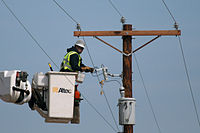
A utility electrician/lineman does maintenance on a utility pole.
Training of electricians follows an apprenticeship model, taking four or five years to progress to fully qualified journeyman level.[6] Typical apprenticeship programs consists of 80-90% hands-on work under the supervision of journeymen and 10-20% classroom training.[7] Training and licensing of electricians is regulated by each province, however professional licenses are valid throughout Canada under Agreement on I nternal Trade. An endorsement under the Red Seal Program provides additional competency assurance to industry standards.[8] In order for individuals to become a licensed electricians, they need to have 9000 hours of practical, on the job training. They also need to attend school for 4 terms and pass a provincial exam. This training enables them to become journeyman electricians. Furthermore, in British Columbia, an individual can go a step beyond that and become a "FSR", or field safety representative. This credential gives the ability to become a licensed electrical contractor and to pull permits. Notwithstanding this, some Canadian provinces only grant "permit pulling privileges" to current Master Electricians, that is, a journeyman who has been engaged in the industry for three (3) years AND has passed the Master's examination (i.e. Alberta). The various levels of field safety representatives are A,B and C. The only difference between each class is that they are able to do increa singly higher voltage and current work.
United Kingdom
Competency standards in the UK are defined by the Sector Skills council Summit Skills. Qualifications certificated by awarding organisations such as City and Guilds and EAL are based on these National Occupational Standards. Once qualified and demonstrating the required level of competence an Electrician can register with the JIB (Joint industry Board) for an Electrotechnical Certification Scheme (ECS) card. Electrical competence is required at Level 3 to practice as an electrician in the UK. The electrical industry is one of the few that require a trade test to be achieved prior to being fully qualified. This is known as the AM2.
Electricians can demonstrate further competence by studying further qualifications in Design and Verification of Electrical Installations or in the Test and Inspection of Electrical Installations. These qualifications can be listed on the reverse of the JIB card.
The Electri city at Work Regulations are the statutory document that covers electrical installations. Further information is provided in the non-statutory document BS7671 - Requirements for Electrical Installations otherwise known as the Wiring Regulations currently (2013) in their 17th Edition. Installations that comply with BS7671 are deemed to have met the EAWR. Electrical Installation in domestic properties is governed by Part P of the Building Regulations and electricians have to register certain aspects of their work in domestic properties with the local building control authority.
With the exception of the work described in Part P of the Building Regulations there are no laws that prevent anyone from carrying out electrical work in the UK. A possible result of this is that during 2010/11 and in 2011/12 there were 3,822 domestic electrical fires in Great Britain, resulting in 14 deaths. Organisations such as the Electrical Safety Council are working hard to educate the public not t o use electricians who are not fully qualified or competent and to check the ElectricSafe register to ensure an Electrician has been deemed competent.
United States
Although many electricians work for private contractors, many electricians get their start in the military.
The United States does not offer nationwide licensing and electrical licenses are issued by individual states. There are variations in licensing requirements, however, all states recognize three basic skill categories: level electricians. Journeyman electricians can work unsupervised provided tha t they work according to a master's direction. Generally, states do not offer journeyman permits, and journeyman electricians and other apprentices can only work under permits issued to a master. Apprentices may not work without direct supervision.[9]
Before electricians can work unsupervised, they are usually required to serve an apprenticeship lasting from 3 to 5 years under the general supervision of a Master Electrician and usually the direct supervision of a Journeyman Electrician.[9] Schooling in electrical theory and electrical building codes is required to complete the apprenticeship program. Many apprenticeship programs provide a salary to the apprentice during training. A Journeyman electrician is a classification of licensing granted to those who have met the experience requirements for on the job training (usually 4000 to 6000 hours) and classroom hours (about 144 hours). Requirements include completion of two to six years of apprenticeship training, and passing a licensing exam.[10][11]
Reciprocity
An electrician's license is valid for work in the state where the license was issued. In addition, many states recognize licenses from other states, sometimes called interstate reciprocity participation, although there can be conditions imposed. For example, California reciprocates with Arizona, Nevada, and Utah on the condition that licenses are in good standing and have been held at the other state for five years.[12] Nevada reciprocates with Arizona, California, and Utah.[13] Maine reciprocates with New Hampshire and Vermont at the master level, and the state reciprocates with New Hampshire, North Dakota, Idaho, Oregon, Vermont, and Wyoming at the journeyman level.[14]
Tools
Electricians use a range of hand and power tools and instruments.
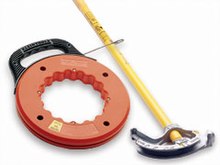
Two of the tools commonly used by electricians. The fish tape is used to pull conductors through conduits, or sometimes to pull conductors through hollow walls. The conduit bender is used to make accurate bends and offsets in electrical conduit.
Some of the more common tools are:
Conduit Bender: Bender used to bend various types of Electrical Conduit. These come in many variations including hand, electrical, and hydraulic powered.
Non-Contact Voltage Testers
Lineman's Pliers: Heavy-duty pliers for general use in cutting, bending, crimping and pulling wire.
Diagonal Pliers (also known as side cutters or Dikes): Pliers consisting of cutting blades for use on smaller gauge wires, but sometimes also used as a gripping tool for removal of nails and staples.
Needle-Nose Pliers: Pliers with a long, tapered gripping nose of various size, with or without cutters, generally smaller and for finer work (including very small tools used in electronics wiring).
Wire Strippers: Plier-like tool available in many sizes and designs featuring special blades to cut and strip wire insulation while leaving the conductor wire intact and without nicks. Some wire strippers include cable strippers among their multiple functions, for removing the outer cable jacket.
Cable Cutters: Highly leveraged pliers for cutting larger cable.
Multimete r: An instrument for electrical measurement with multiple https://www.youtube.com/watch?v=aWoSWNwtVKA functions. It is available as analog or digital display. Common features include: voltage, resistance, and current. Some models offer additional functions.
Unibit or Step-Bit: A metal-cutting drill bit with stepped-diameter cutting edges to enable convenient drilling holes in preset increments in stamped/rolled metal up to about 1.6mm (1/16 inch) thick. Commonly used to create custom knock-outs in a breaker panel or junction box.
Cord, Rope or Fish Tape. Used to manipulate cables and wires through cavities. The fishing tool is pushed, dropped, or shot into the installed raceway, stud-bay or joist-bay of a finished wall or in a floor or ceiling. Then the wire or cable https://www.youtube.com/watch?v=aWoSWNwtVKA is attached and pulled back.
Crimping Tools: Used to apply terminals or splices. These may be hand or hydraulic powered. Some hand tools have ratchets to insure proper pressure. Hydraulic units achieve cold welding, even for aluminum cable.
Insulation Resistance Tester: Commonly referred to as a Megger, these testers apply several hundred to several thousand volts to cables and equipment to determine the insulation resistance value.
Knockout Punch: For punching holes into boxes, panels, switchgear, etc. for inserting cable & pipe connectors.
GFI/GFCI Testers: Used to test the functionality of Ground-Fault Interrupting receptacles.
Voltmeter: An electrician's tool used to measure electrical potential difference between two points in an electric circuit.
Other general-use tools include screwdrivers, hammers, reciprocating saws, drywall saws, flashlights, chisels, tongue and groove pliers (Commonly referred to as 'Channellock' pliers, a famous manufacturer of this tool) and drills.
Safety
See also: Occupational safety and health
In addition to the workplace hazards generally faced by industrial workers, electricians are also particularly exposed to injury by electricity. An electrician may experience electric shock due to direct contact with energized circuit conductors or due to stray voltage caused by faults in a system. An electric arc exposes eyes and skin to hazardous amounts of heat and light. Faulty switchgear may cause an arc flash incident with a resultant blast. Electricians are trained to work safely and take many measures to minimize the danger of injury. Lockout and tagout procedures are used to make sure that circuits are proven to be de-energized before work is done. Limits of approach to energized equipment protect against arc flash exposure; specially designed flash-resistant clothing provides additional protection; grounding (earthing) clamps and chains are used on line conductors to provide a visible assurance that a conductor is de-energized. Personal protective equipment provides electrical insulation as well as protection from mechanical impact; gloves have insulating rubber liners, and work boots and hard hats are specially rated to provide protection from shock. If a system cannot be de-energized, insulated tools are used; even high-voltage transmission lines can be repaired while energized, when necessary.[15]
Electrical workers, which includes electricians, accounted for 34% of total electrocutions of construction trades workers in the United States between 1992-2003.[16]
Working conditions
Working conditions for electricians vary by specialization. Generally an electrician's work is physically demanding such as climbing ladders and lifting tools and supplies. Occasionally an electrician must work in a cramped space or on scaffolding, and may frequently be bending, squatting or kneeling, to make connections in awkward locations. Construction electricians may spend much of thei r days in outdoor or semi-outdoor loud and dirty work sites. Industrial electricians may be exposed to the heat, dust, and noise of an industrial plant. Power systems electricians may be called to work in all kinds of adverse weather to make emergency repairs.
Trade organizations
Some electricians are union members and work under their union's policies.
Australia
Electricians can choose to be represented by the Electrical Trade Union (ETU). Electrical Contractors can be represented by the National Electrical & Communications Association or Master Electricians Australia.
North America
Some electricians are union members. Some examples of electricians' unions include the International Brotherhood of Electrical Workers, Canadian Union of Public Employees, and the International Association of Machinists and Aerospace Workers.
The International Brotherhood of Electrical Workers provides its own apprenticeships through its National Joint Ap prenticeship and Training Committee and the National Electrical Contractors Association. Many merit shop training and apprenticeship programs also exist, including those offered by such as trade associations as Associated Builders and Contractors and Independent Electrical Contractors. These organizations provide comprehensive training, in accordance with U.S. Department of Labor regulations.
England/Ireland
In England, electricians are represented by several unions including Unite the Union
In the Republic of Ireland there are two self-regulation/self certification bodies RECI Register of Electrical Contractors of Ireland and ECSSA.
Auto electrician
An auto electrician is a tradesman specializing in electrical wiring of motor vehicles. Auto electricians may be employed in the installation of new electrical components or the maintenance and repair of existing electrical components. Auto electricians specialize in cars and commercial vehicles. See also
Lineman (Technician)
Gaffer (Term used in film and television)
International Brotherhood of Electrical Workers
List of electricians, notable individuals who have worked as electricians
References
^ Roger Jones (2004). Electrician. Trotman Publishing. ISBN0-85660-997-8.
^ Shock and Awe: The Story of Electricity- Jim Al-Khalili
^ Tester, Ross (2008-06-05). "DIY Electrical Work: Are Aussies DUMBER than Kiwis?". Silicon Chip Online. Retrieved 2012-07-20.
^ "What Is a Journeyman Electrician?". Retrieved 2017-01-29.
^ http://www.cslb.ca.gov/applicants/Reciprocity/ReciprocityRequirements.asp CSLB CA
^ http://www.nvcontractorsboard.com/reciprocity.html State of NV
^ http://www.maine.gov/pfr/professionallicensing/professions/electricians/pdf/elecreciprocity.pdf State of ME
^ John Cadick et al, Electrical Safety Handbook Third Edition, Mc Graw Hill 2005, ISBN 0-07-145772-0
^ http://www.elcosh.org/en/document/557/d000539/why-are-so-many-construction-workers-being-electrocuted%253F.html Michael McCann, Why Are So Many Construction Workers Being Electrocuted?, retrieved 2010 July 27
External links
Wikimedia Commons has media related to Electricians.
Occupational Outlook Handbook
Retrieved from "https://en.wikipedia.org/w/index.php?title=Electrician&oldid=784490164"
This material may not be published, broadcast, rewritten, or redistributed. 2017 FOX News Network, LLC. All rights reserved. All market data delayed 20 minutes.